
How to Inspect and Retire Lifting Slings: The Ultimate Rejection Criteria Guide
May 26, 2026
Every year, lifting sling failures cause serious injuries and fatalities worldwide. The sad truth? Most of these accidents are preventable—with proper inspection and timely retirement of worn equipment. This comprehensive guide covers everything you need to know about inspecting synthetic slings, webbing slings, and round slings, plus the exact rejection criteria that could save a life.
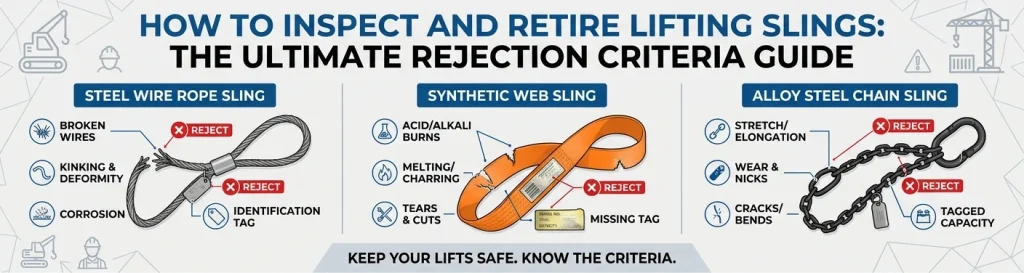
Why Regular Sling Inspection Matters
Lifting slings are subjected to extreme stresses during operation. Even the highest-quality slings degrade over time due to:
- Abrasion — Repeated friction against loads andEdges
- Cut damage — Sharp edges or foreign objects
- Chemical exposure — Acids, alkalis, or solvents
- Ultraviolet (UV) degradation — Sun exposure weakens fibers
- Thermal damage — Excessive heat exposure
- Shock loading — Sudden impact forces
⚠️ Critical: According to OSHA and CE standards, lifting slings must be visually inspected before EACH use. A damaged sling in operation is a catastrophe waiting to happen.
Three Levels of Sling Inspection
- Initial Inspection – before first use or after repair: verify specs, batch, label, no transit damage.
- Frequent (Pre‑Use) Inspection – visual + tactile before every lift: obvious damage, tags, fittings.
- Periodic Inspection – documented thorough check by a competent person:
- General service: at least every 12 months
- Severe, chemical, high‑temperature: 3–6 months
Step-by-Step Inspection Procedure
Step 1: Prepare for Inspection
- Clean the sling to remove dirt, oil, or debris
- Ensure adequate lighting
- Have inspection checklist ready
- Check the sling’s identification tag is legible
Step 2: Visual Examination
Inspect the entire length of the sling, including:
- Webbing surfaces — Both inside and outside
- Stitching — All sewn areas
- Fitting attachments — Hooks, eyes, links
- Identification label — WLL and material info
Step 3: Functional Check
- Bend the sling to check for broken yarns
- Check for flexibility loss
- Verify no knots or kinks
- Ensure fittings rotate freely
Sling Rejection Criteria: When to Retire Immediately
The following conditions mandate immediate removal from service:
| Defect Type | Rejection Criterion | Severity |
|---|---|---|
| Broken Yarns | Any visible broken yarns in load-bearing direction | CRITICAL |
| Cuts/Abrasion | Deep cuts, tears, or abrasion exceeding 10% of webbing thickness | CRITICAL |
| Knots | Any knot in the sling | CRITICAL |
| Burn Marks | Melted, scorched, or discolored areas | CRITICAL |
| Holes | Any hole in the webbing | CRITICAL |
| Stitching Damage | Broken, worn, or damaged stitches | HIGH |
| Eye Damage | Deformed, cracked, or worn eyes/splices | HIGH |
| Acid/Alkali Damage | Fiber breakdown, brittle texture, discoloration | CRITICAL |
| UV Degradation | Significant fading, chalky appearance, brittle feel | HIGH |
| Missing Tag | Illegible or missing identification tag | HIGH |
| Fitting Wear | Cracked, deformed, or >10% wear on fittings | HIGH |
| Improper Storage | Kinks, permanent deformation, set | HIGH |
🚫 NEVER Use a Sling If:
- You see any broken yarns
- The sling has been shocked or dropped
- You suspect chemical exposure
- The identification tag is missing or illegible
- There’s any doubt about the sling’s condition
Inspection Frequency Guidelines
| Application Type | Inspection Frequency |
|---|---|
| General Industry Use | Before each use + Periodic formal inspection |
| Severe Service Conditions | Before each use + Weekly formal inspection |
| Critical Lifting Operations | Before each use + Daily formal inspection |
| Rigorous/Dangerous Loads | Before each use + Shift inspection |
| Idle/Storage Slings | Before re-enteringservice |
Documentation: Maintain Inspection Records
Proper records protect your company and workers. Maintain asling inspection log including:
- Date of inspection
- Inspector name
- Sling identification number/tag
- Condition noted
- Action taken (passed, removed, repaired)
- Signature
💡 Best Practice: Assign a unique ID to each sling and track its service history. Replace slings proactively based on service age and usage conditions—not just when they fail inspection.
Safe Disposal: How to Retire Slings
When a sling reaches its retirement criteria:
- Mark it clearly — Use bright paint or tag as “UNSAFE”
- Remove from service immediately — Isolate from usable equipment
- Document the retirement — Record reason, date, inspector
- Dispose properly — Cut into pieces to prevent reuse, or recycle per local regulations
Partner with LDR Rigging for Certified Safety
All LDR webbing slings, round slings, and rigging hardware meet CE, GS, EN 1492 and international standards. Every batch undergoes tensile testing to ensure reliable break‑load performance.
Regular inspection and proper retirement are legal requirements—and moral obligations. A systematic program protects your workers, equipment investment, and reputation.
🔗 Explore our catalog at www.ldrsling.com or contact our technical team for factory-direct pricing quotes.

.png)


.png)
.png)